





Skip to content
5-star rating on Google · Service business marketing consulting experts Book Strategy Call
Strategy 25 min read · July 2026

Digital Marketing For Service Businesses That Drives Booked Jobs

Learn how service businesses turn local searches into qualified leads, booked jobs, and profitable revenue with SEO, ads, reviews, and follow-up.

Digital Marketing For Service Businesses: Get More Booked Jobs — digital marketing for service businesses

Digital Marketing for Service Businesses: Turn Local Searches Into Booked Jobs in 2026

Digital marketing for service businesses is a booked-job growth system. It connects local search visibility, Google Maps, paid search, reviews, service-area pages, lead response, sales follow-up, and revenue reporting.

A disconnected list of tactics can produce traffic and form fills. A working system moves a homeowner from a search such as “emergency plumber near me” to a qualified call, a scheduled visit, a sold job, completed revenue, repeat work, and referrals.

That distinction matters. An HVAC company may rank well but miss calls after 6 p.m. A roofer may buy leads but fail to follow up on estimates. A tree service may receive plenty of inquiries outside its service radius. Marketing did its part, but the business did not book the work.

This guide shows how contractors can connect each handoff and judge every channel by profitable booked jobs.

"Learn how service businesses turn local searches into qualified leads, booked jobs, and profitable revenue with SEO, ads, reviews, and follow-up."

Key takeaway

What Digital Marketing for Service Businesses Really Includes

Service business marketing covers the full path between demand and revenue:

  1. 01 Discovery: A customer finds the company in Google Search, Google Maps, a paid ad, a local directory, a review platform, Apple Maps, or an answer engine.
  2. 02 Evaluation: The customer checks services, service areas, reviews, photos, licensing information, financing, warranties, and project proof.
  3. 03 Contact: The customer calls, submits an estimate form, starts a chat, or sends a message.
  4. 04 Qualification: Office staff confirm the job type, location, urgency, budget fit, and scheduling needs.
  5. 05 Booking: The company schedules an appointment or estimate.
  6. 06 Sale: A salesperson or technician presents a suitable option and records the result.
  7. 07 Revenue: The company completes the work, collects payment, and tracks gross profit.
  8. 08 Retention: The customer returns for maintenance, another project, or a referral.

Google says local results are mainly shaped by relevance, distance, and prominence in its local ranking guidance. Those signals affect whether a homeowner sees an HVAC business in one ZIP code, a roofer in another city, or an electrician near a particular address.

The same pattern applies across trades:

  • ·HVAC: “AC repair tonight” requires strong Maps visibility, a working emergency phone line, and rapid dispatch.
  • ·Plumbing: “Burst pipe repair” needs urgent language, geographic controls, and a person answering the phone.
  • ·Roofing: “Roof replacement estimate” needs project photos, financing details, reviews, and persistent estimate follow-up.
  • ·Electrical: “Panel upgrade” may need educational content because the customer often compares options before calling.
  • ·Remodeling: A kitchen renovation page must show project scope, timelines, photos, and a clear estimate process.
  • ·General contracting: Customers need proof that the company manages larger jobs, permits, subcontractors, and communication.
  • ·Tree service: Emergency removal and scheduled trimming should use different pages, ad groups, response rules, and price expectations.

I recommend thinking in terms of search visibility plus operational follow-through. Traffic creates a chance. The phone answer, booking process, estimate, and sale create the business result.

For a practical look at this model, see ServiceLine Pro’s guide to results-driven service business marketing.

Start With Job Economics, Not Marketing Channels

Before choosing SEO, Google Ads, Local Services Ads, or another source, write down the economics of the work you want.

Use this worksheet for each trade and service:

  • ·Target cities and ZIP codes
  • ·Services you want more often
  • ·Average ticket
  • ·Gross margin percentage
  • ·Gross profit per completed job
  • ·Estimate-to-sale rate
  • ·Lead-to-appointment rate
  • ·Appointment-to-sold-job rate
  • ·Monthly job capacity
  • ·Monthly revenue target
  • ·Maximum acceptable cost per booked job

Suppose a plumbing company has these numbers:

  • ·Average ticket: $1,800
  • ·Gross margin: 45%
  • ·Gross profit: $810
  • ·Sold-job rate from qualified appointments: 50%
  • ·Maximum share of gross profit assigned to acquisition: 30%

The maximum cost per booked job would be:

$810 × 30% = $243

The company should not treat $243 as a guaranteed target. It is a ceiling for testing. Overhead, warranty work, discounts, and technician costs may require a lower figure.

To work backward to an allowable cost per lead, multiply the maximum booked-job cost by the lead-to-booked-job rate. If 20% of qualified leads become booked jobs:

$243 × 20% = $48.60 allowable cost per qualified lead

Do not use raw leads in that calculation. A duplicate, spam inquiry, wrong service, or out-of-area request is not a qualified lead.

A $100 lead may be profitable for a $12,000 roof replacement and unprofitable for a $250 drain cleaning. Emergency demand often costs more because many companies compete for the same immediate search. Planned remodeling work may accept a longer sales cycle because one closed project can produce much more gross profit.

Budget should follow four variables:

  1. 01 Job value: Higher-ticket work can support a higher acquisition cost.
  2. 02 Urgency: Emergency services often justify paid search and extended phone coverage.
  3. 03 Competition: A crowded city may require more budget or a narrower service focus.
  4. 04 Capacity: A full crew cannot benefit from traffic the business cannot serve.

A contractor moving from $1 million to $10 million in annual revenue should not simply buy ten times as many leads. The company needs profitable service lines, dispatch capacity, sales coverage, repeatable hiring, fast response, and reliable reporting. Marketing can expand one city, service, or crew at a time after the economics hold.

The cost-per-lead guide for service businesses gives contractors a useful way to frame this calculation by trade and market.

The Service-business Marketing Funnel: From Search to Booked Job

A useful funnel has these stages:

  • ·Stage — What to measure — Who owns the handoff
  • ·Impression — Search visibility, Maps appearance, ad impression — Marketing
  • ·Click or call — Qualified page visit, call, form, chat — Marketing and office
  • ·Qualified lead — Service, location, urgency, fit — Office
  • ·Scheduled appointment — Date, time, assigned team — Office and dispatch
  • ·Estimate — Scope, price, options, objections — Technician or salesperson
  • ·Sold job — Signed work, deposit, financing — Sales and operations
  • ·Completed revenue — Collected amount and gross profit — Operations and finance
  • ·Repeat or referral — Maintenance, next project, referral — Service and customer care

A lead is not the outcome. A campaign that generates 100 forms but only two appointments may look busy while producing weak economics. A campaign that generates 20 calls and 10 profitable jobs may deserve more budget.

Set CRM stages with fixed definitions. “New lead” means a contact arrived. “Qualified” means the job and location fit. “Booked” means an appointment exists on the schedule. “Sold” means the customer accepted the work. “Completed” means the company collected or invoiced revenue.

Marketing should see source and campaign data. Office staff should record qualification and booking. Salespeople should record estimates and outcomes. Technicians should flag service type, replacement opportunity, and follow-up needs. One missing stage can make a winning channel look weak or hide waste.

Build the Local SEO Foundation

Local SEO for service businesses starts with a complete and accurate Google Business Profile. Google permits service-area businesses to hide a residential address when customers do not visit that location. A contractor should not create fake offices or claim cities where the company does not serve customers.

Set up the profile with care:

  • ·Choose the category that best describes the company’s main service.
  • ·Add accurate secondary categories when they truly apply.
  • ·List services in plain customer language.
  • ·Keep the phone number, hours, website, and appointment link accurate.
  • ·Define legitimate service areas.
  • ·Add real team, vehicle, project, equipment, and completed-work photos.
  • ·Publish useful updates when there is a genuine announcement, seasonal service, project, or answer to a customer question.
  • ·Check the profile after staffing, hours, or address changes.

Google says businesses cannot create a listing for every location they serve when they lack a staffed location there. One legitimate service-area profile is better than a collection of misleading listings.

Citations still help establish consistent business information. Keep the company name, address or service-area details, phone number, website, and category consistent across reputable directories. Trade associations, chambers of commerce, suppliers, community groups, sponsorships, and local project coverage can support local authority when they are genuine.

Useful content should answer real questions:

  • ·Does the company serve this city?
  • ·Which neighborhoods receive emergency calls?
  • ·Does the company repair or replace this equipment?
  • ·What does an estimate include?
  • ·What permits or inspections may apply?
  • ·What should a homeowner do before the crew arrives?

Local SEO timelines vary. A company with a strong profile, many genuine reviews, an established website, and little competition may see movement sooner than a new business entering a crowded market. Proximity to the searcher, existing authority, review history, profile quality, content, and execution all affect the timeline. No agency can honestly promise a fixed ranking date.

How to Win Google Maps in the ZIP Codes You Serve

Google’s local model uses relevance, distance, and prominence. A company can be highly relevant for “water heater replacement” yet appear lower when the searcher sits far outside its normal service area. A large review count does not erase distance.

Use a ZIP-code process:

  1. 01 List profitable ZIP codes by service, not by population alone.
  2. 02 Record current Maps visibility for searches such as “HVAC repair,” “AC replacement,” “roof repair,” and “tree removal.”
  3. 03 Check results from consistent locations or a rank-tracking tool without treating one scan as absolute truth.
  4. 04 Improve the profile and the matching service page.
  5. 05 Earn genuine reviews from customers in the areas actually served.
  6. 06 Add local project proof, neighborhood details, and useful service information.
  7. 07 Build real local relationships and citations.
  8. 08 Track calls, forms, booked appointments, and revenue from each area.

Do not claim the entire metro area if crews cannot serve it profitably. Prioritize five ZIP codes where the company has good close rates, short travel time, and enough demand. Expand after the first group produces acceptable booked-job economics.

Evaluate Maps by business result, not rank alone. A monthly report should show:

  • ·Searches or profile interactions where available
  • ·Calls from the profile
  • ·Website visits from the profile
  • ·Direction requests when relevant
  • ·Qualified calls
  • ·Appointments
  • ·Sold work
  • ·Revenue by service and ZIP code

A rank can improve while calls fall because demand changed, hours are wrong, reviews declined, or a competitor improved its listing. Revenue tells the fuller story.

Create a Service-Area Website That Ranks and Converts

A service-area website needs a page structure that matches profitable demand. Build dedicated pages for services and priority locations, such as:

  • ·Emergency HVAC repair in Tampa
  • ·Water heater replacement in Orlando
  • ·Roof replacement in Jacksonville
  • ·Electrical panel upgrades in Fort Lauderdale
  • ·Kitchen remodeling in Sarasota
  • ·Tree removal in St. Petersburg

Each page should contain original information, not a city name swapped into the same paragraph. Add:

  • ·Services offered and services excluded
  • ·Local service boundaries
  • ·Common causes and warning signs
  • ·What the visit or estimate includes
  • ·Real project photos and descriptions
  • ·Customer reviews tied to the work when permitted
  • ·Permits, warranties, financing, or maintenance details where relevant
  • ·Local weather, building, or housing considerations when accurate
  • ·FAQs that answer actual calls
  • ·A phone number and estimate action

A location page for roof replacement should discuss inspection, decking, ventilation, material choices, permits, cleanup, and local project proof. A thin page that says “We serve City X” five times adds little.

Google warns against doorway pages that exist mainly to rank for similar searches and send users to one destination. The safest way to rank in multiple cities is to create useful pages for real markets and give each page a reason to exist.

A sensible site structure includes:

  • ·Core service pages
  • ·Priority city and service-area pages
  • ·About and trust pages
  • ·Contact and estimate pages
  • ·Financing, warranty, maintenance, or service-plan pages where relevant
  • ·Project galleries and case studies
  • ·Educational content that supports customer decisions
  • ·Privacy, terms, and required business disclosures

ServiceLine Pro’s digital marketing for service businesses resources can help a contractor connect page planning with lead generation.

Make the Website Turn Mobile Visits Into Calls

Service-business searches often happen on a phone, especially during a leak, outage, broken air conditioner, or storm event. The mobile page should answer three questions within seconds:

  1. 01 Can this company handle my job?
  2. 02 Does it serve my location?
  3. 03 How do I reach someone now?

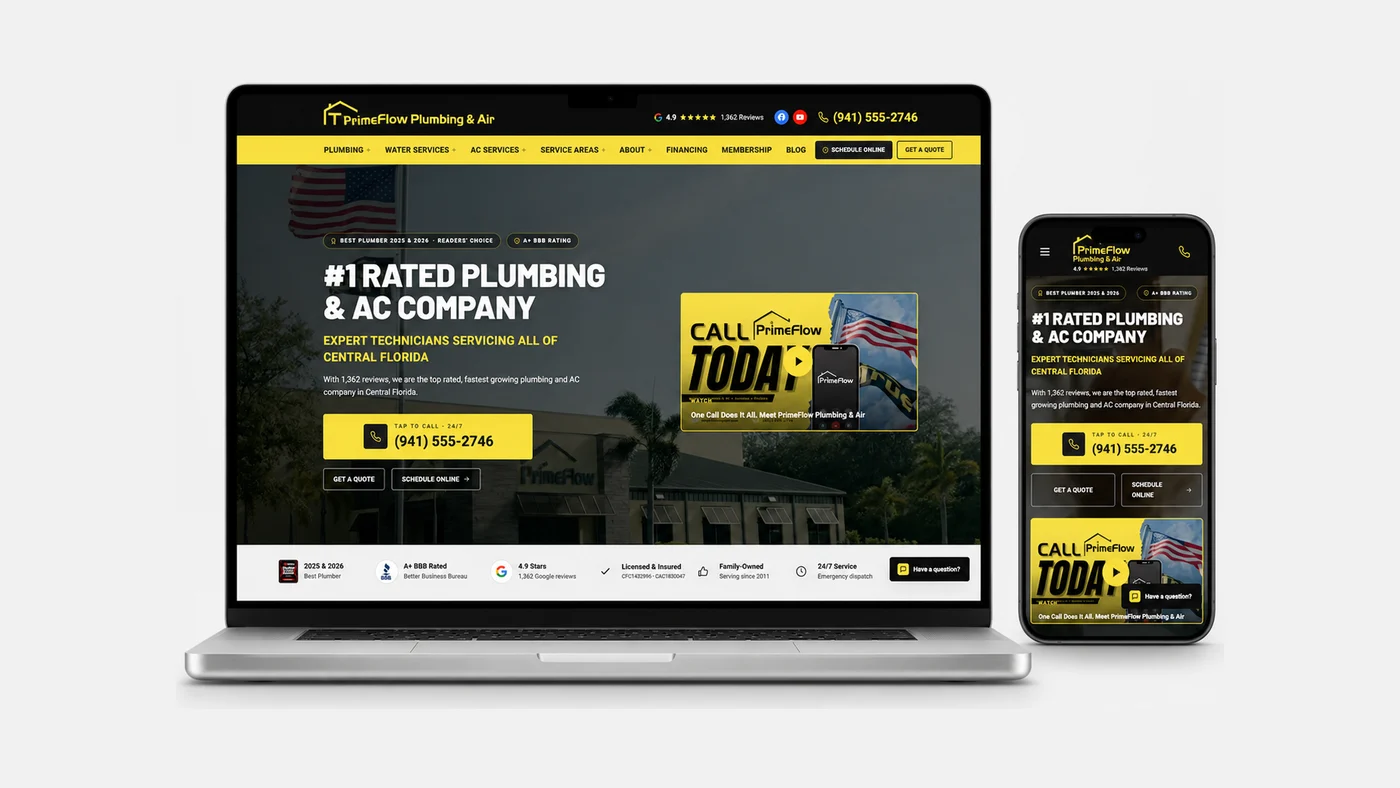
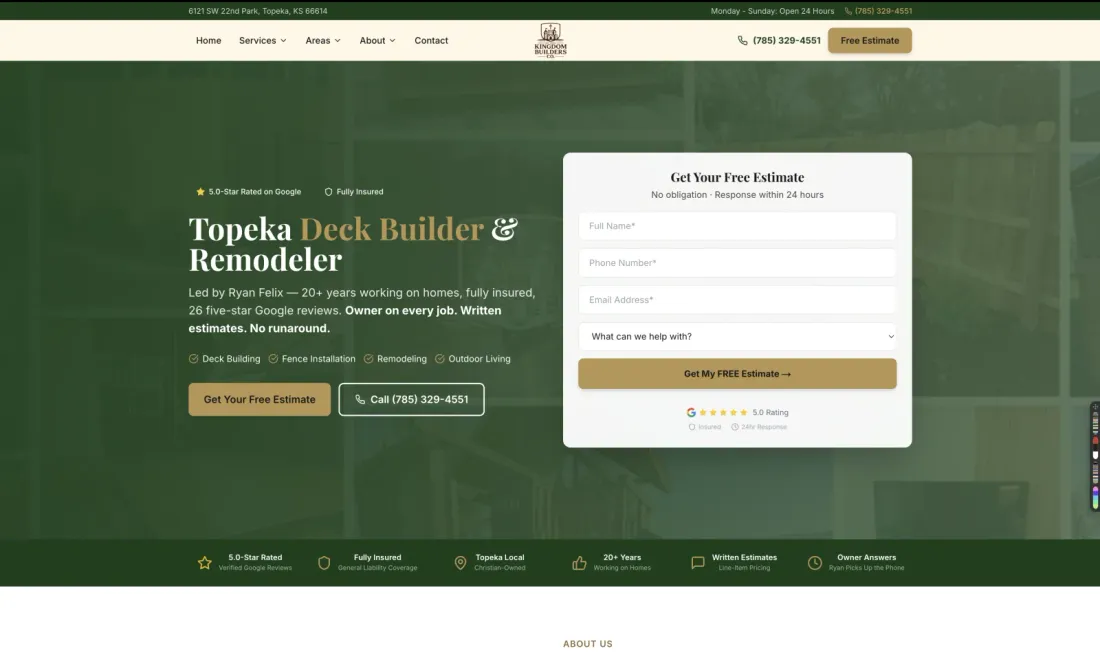
Use a visible tap-to-call button, a short estimate form, clear service-area language, trust signals, real project proof, and a direct next step above the fold. Keep the phone number clickable. Do not bury the contact action beneath a long company history.

Match the CTA to intent:

  • ·Emergency HVAC: “Call now for service”
  • ·Plumbing repair: “Speak with a plumber”
  • ·Roof replacement: “Request a roof estimate”
  • ·Remodeling: “Schedule a project consultation”
  • ·Tree trimming: “Get a property assessment”

A planned-service visitor may want photos, financing, warranties, and a form. An emergency visitor may leave if the company asks for ten fields before showing a phone number.

Measure calls, completed forms, chat conversations, missed calls, qualified contacts, and booked work. Raw form volume can mislead. Test page headlines, call buttons, form length, proof, and service-area language against qualified inquiries and booked jobs.

A fast, clear website helps both organic visitors and paid traffic. The business website management guide covers the maintenance work that keeps contact paths, service information, and tracking in working order.

Use Google Ads for High-Intent Service-business Demand

Google Ads gives a contractor immediate access to searches with strong intent, but the account needs tight structure. Separate campaigns by:

  • ·Trade
  • ·Service
  • ·Emergency versus planned work
  • ·Priority city or service area
  • ·Call-focused versus form-focused intent

An HVAC account might separate emergency AC repair, AC installation, heat pump replacement, and maintenance. A roofing account might separate storm damage, roof repair, replacement, and commercial roofing.

Build each campaign around search intent. Add negative keywords such as jobs, training, wholesale supplies, DIY, parts, and unrelated commercial searches when they do not fit the business. Review the search-term report every week during the first month.

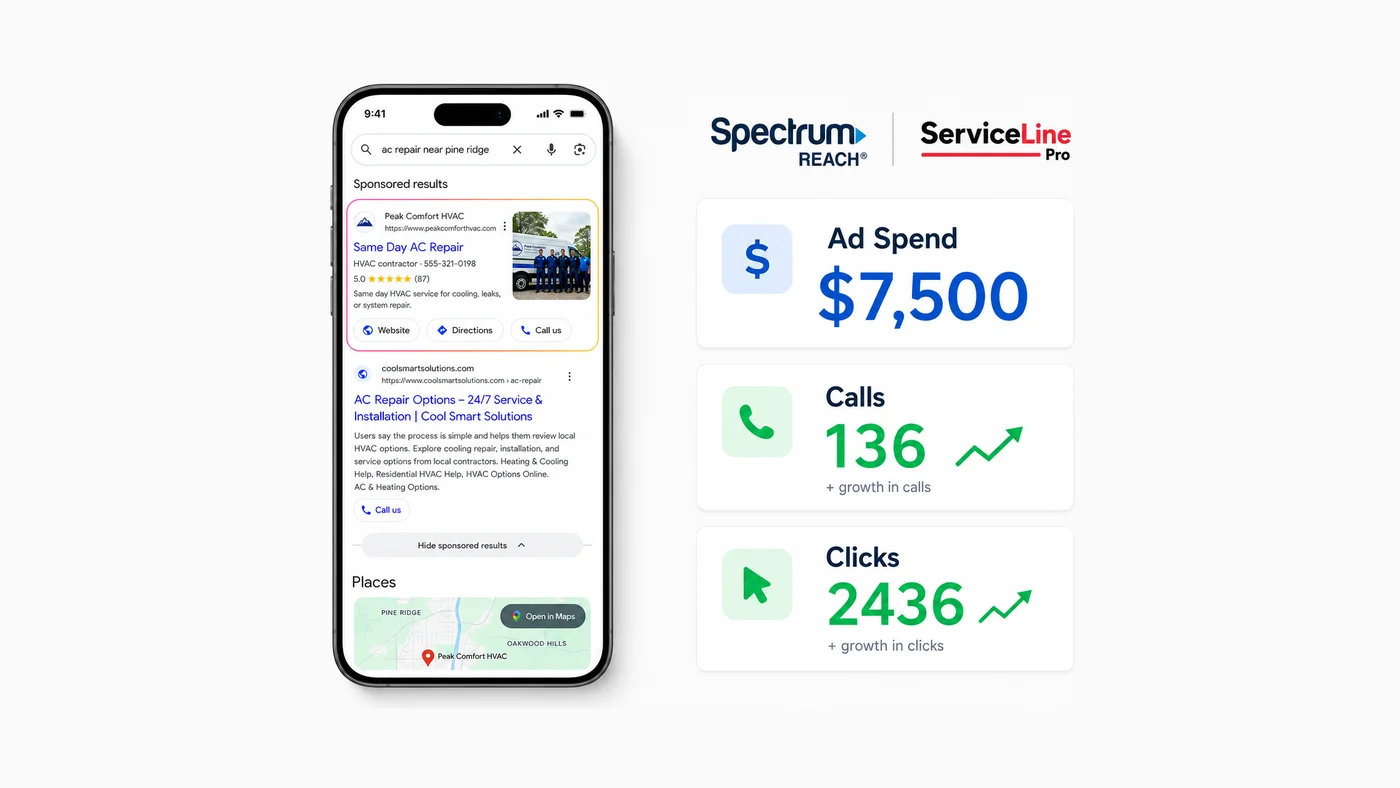
Use geographic controls carefully. Exclude locations outside the profitable service area, set schedules around phone coverage, and avoid sending emergency ads when no one can answer. Call assets, location information, service-specific ad copy, and matching landing pages reduce friction.

Paid search suits emergency HVAC, plumbing, electrical repair, locksmith work, and urgent tree removal because the customer may need help today. Roofing replacement, remodeling, and general contracting often need a mix of paid search, project proof, SEO, remarketing where lawful, and repeated estimate follow-up.

Paid search offers speed and budget control. SEO usually takes longer but can build a durable source of clicks and calls after the pages and authority mature. Many contractors need both: paid search for immediate demand and local SEO for compounding visibility.

Use ad campaign optimization for service businesses as a review checklist, then judge every campaign by qualified calls, appointments, sold work, and gross profit.

Evaluate Local Services Ads and Pay-Per-Lead Programs

Google Local Services Ads and other pay-per-lead programs can help a contractor gain visibility quickly. The company pays for inquiries that meet the platform’s definition of a lead, rather than for every click.

That model does not make every inquiry profitable. Track each lead by:

  • ·Service requested
  • ·City and ZIP code
  • ·Urgency
  • ·New or repeat customer
  • ·Duplicate status
  • ·Spam status
  • ·Qualified or unqualified
  • ·Appointment outcome
  • ·Sold-job outcome
  • ·Revenue and gross profit

Calculate effective cost per booked job:

Total program spend ÷ booked jobs

Compare that figure with the maximum cost the job economics permit. A $60 lead cost may look low, but 1 in 12 leads becoming a booked job produces a $720 acquisition cost. A $110 lead cost can work when 1 in 3 inquiries books a profitable job.

Before buying leads, set up call recording where lawful, source tracking, CRM stages, duplicate checks, dispute rules, and a process for documenting spam or wrong-service inquiries. A contractor should know who owns the lead, whether it is shared, how quickly the company must respond, and how refunds or disputes work.

Pay-per-lead is worth testing when it fills a short-term demand gap and the booked-job economics hold. It is a poor choice when the business accepts every inquiry without qualification or cannot answer the phone.

Use Reviews and Reputation to Convert More Searchers

Reviews affect trust across Maps, the website, paid traffic, and estimate follow-up. Google’s prohibited and restricted content policy bars fake engagement and other forms of manipulated review activity.

Use a simple review process:

  1. 01 Complete the job or reach a natural service point.
  2. 02 Ask the real customer for honest feedback.
  3. 03 Send one direct review link or clear instruction.
  4. 04 Make the request easy on mobile.
  5. 05 Respond professionally to positive and negative feedback.
  6. 06 Record recurring complaints and fix the service issue.

Never fabricate reviews, pay for praise, ask only happy customers, or pressure a customer to remove a negative review. Review gating can create compliance and platform problems.

A negative review deserves a prompt response that acknowledges the concern, avoids private details, and invites a direct conversation. The public reply should not argue about every fact. The operational fix matters more than the wording.

Reputation management is not a substitute for good work. It is the public record of the work, communication, arrival time, cleanup, billing, and follow-up that customers experienced.

Fix Lead Response Before Buying More Traffic

Many contractors have a lead problem that is really an answering or booking problem. Missed calls, slow callbacks, unclear service areas, and weak estimate follow-up can waste a strong campaign.

Set up:

  • ·Live answer coverage during advertised hours
  • ·A missed-call text or immediate callback workflow
  • ·After-hours instructions for urgent work
  • ·Call recording where permitted and disclosed
  • ·A qualification script
  • ·Service-area and job-fit checks
  • ·Calendar access for appointment booking
  • ·CRM stages with fixed definitions
  • ·Estimate reminders and follow-up dates

Track these numbers by source:

  • ·Speed to answer
  • ·Contact rate
  • ·Qualified-contact rate
  • ·Appointment rate
  • ·Estimate completion rate
  • ·Estimate close rate
  • ·Booked-job rate
  • ·Average sold value
  • ·Collected revenue

A low contact rate points to phone coverage or data quality. A high contact rate with few appointments points to qualification, price expectations, or scheduling. A strong appointment rate with weak sales points to the estimate process, offer, salesperson, or service fit.

The call tracking marketing guide explains how recorded calls and source-level reporting can show where inquiries become lost opportunities.

Track Revenue From Every Marketing Channel

A contractor needs source data that survives the handoff from ad or listing to CRM and closed revenue. Set up:

  • ·Unique tracking numbers by channel or campaign
  • ·Form source and campaign fields
  • ·UTM tags for paid and social links
  • ·Call recordings and disposition codes
  • ·CRM stages for qualified, booked, sold, and completed
  • ·Revenue and gross-profit fields
  • ·Duplicate and spam labels
  • ·City, ZIP code, service, and salesperson fields

Use clicks and impressions as diagnostic metrics. Make these the decision metrics:

  • ·Qualified leads
  • ·Appointments
  • ·Booked jobs
  • ·Sold jobs
  • ·Completed revenue
  • ·Gross profit
  • ·Cost per booked job
  • ·Customer acquisition cost
  • ·Return on ad spend for paid campaigns

Review the data monthly by trade, service, city, ZIP code, channel, campaign, and salesperson. Decide whether to:

  • ·Scale: The service and area produce booked jobs at an acceptable cost, and the company has capacity.
  • ·Repair: The demand is sound, but calls, pages, qualification, or sales follow-up leak revenue.
  • ·Pause: The source produces poor-fit demand after enough testing.
  • ·Test: A new page, service, ZIP code, schedule, ad message, or follow-up path has a defined hypothesis.

Do not compare an emergency plumbing campaign with a six-month remodeling campaign using one blended lead figure. Compare like with like.

Choose the Right Channel Mix by Trade and Growth Stage

HVAC and plumbing

Prioritize Google Business Profile quality, Maps visibility, high-intent paid search, emergency phone coverage, reviews, service pages, and maintenance or replacement follow-up. Separate repair, replacement, installation, and maintenance. A repair caller may need help now, while a replacement customer may compare brands, financing, warranties, and operating costs.

ServiceLine Pro’s digital marketing guide for HVAC is a useful companion for trade-specific planning.

Roofing, remodeling, and general contracting

Use service and location SEO, project galleries, case studies, reviews, financing information, estimate scheduling, and persistent follow-up. Paid search can work for high-value planned services, but the landing page needs to support a longer decision process.

Electrical and tree service

Separate urgent work from scheduled work. Electrical campaigns may cover outages, panel work, generators, lighting, and inspections. Tree service campaigns may cover storm cleanup, removal, trimming, pruning, and stump grinding. Each service has different search language, job value, travel limits, and response needs.

TV and streaming

TV and streaming can make sense after local search, website conversion, lead response, tracking, and estimate follow-up produce acceptable economics. These channels create wider demand, so use dedicated phone numbers, landing pages, offer codes, and geographic testing. Do not judge a broad brand campaign by last-click search data alone, but do insist on a measurement plan before spending heavily.

Prepare for AI Search and Apple Maps Discovery

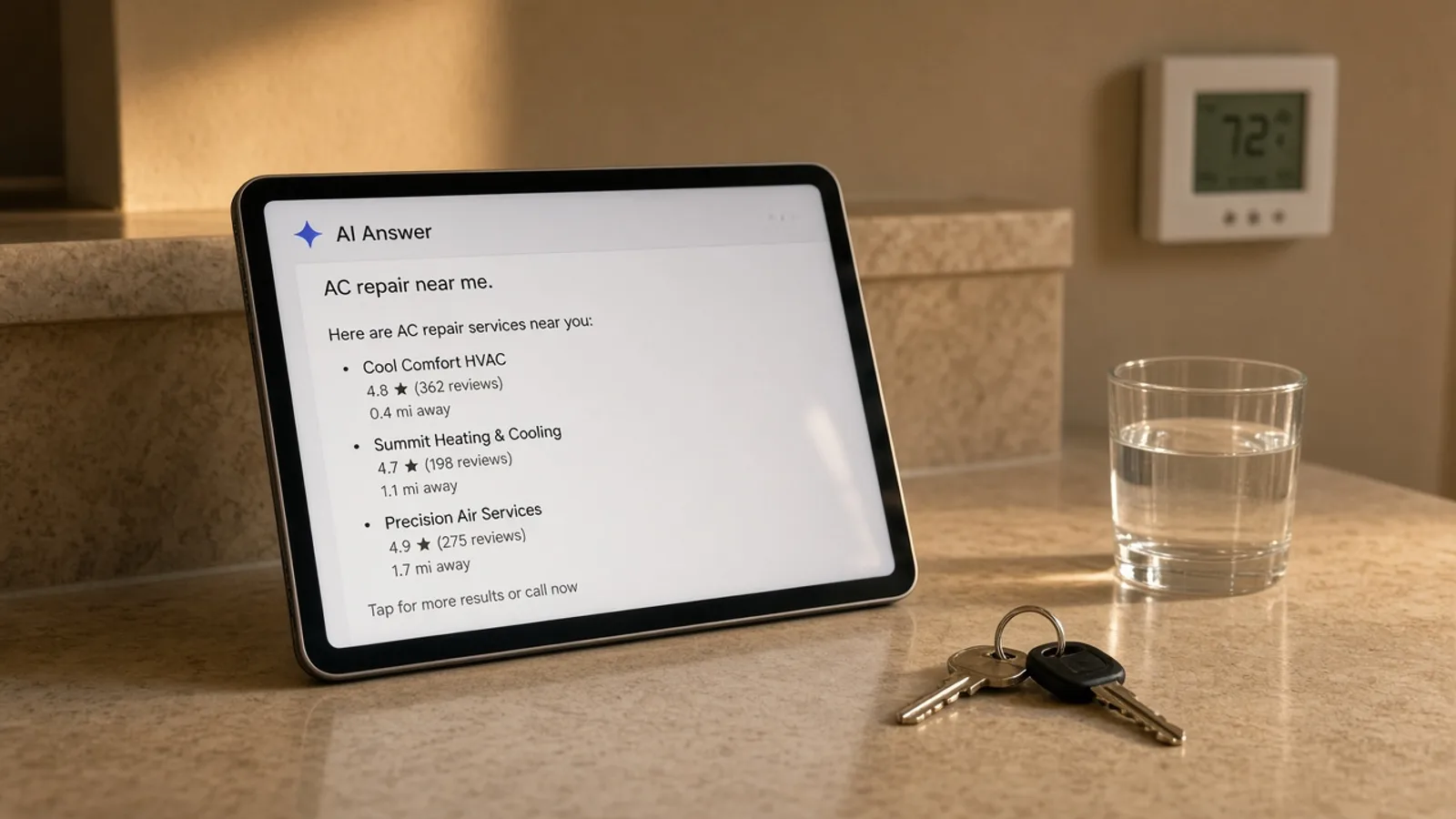
AI SEO for contractors starts with accurate, useful information. ChatGPT and other answer engines need clear signals about what a company does, where it works, which services it offers, and why customers trust it.

Strengthen the source information:

  • ·Keep business name, phone, hours, service areas, and categories consistent.
  • ·Publish clear service and location pages.
  • ·Show real project proof and customer outcomes.
  • ·Explain qualifications, licenses, warranties, financing, and service limits accurately.
  • ·Earn genuine reviews and local mentions.
  • ·Use structured information where it accurately describes the business.
  • ·Keep pages readable for people, not just search systems.

This work supports Google SEO too. A contractor should not abandon Google Maps or organic search while waiting for an answer engine to send a lead.

ChatGPT has announced advertising as an area to watch, but availability, formats, eligibility, and pricing can change. Treat ChatGPT Ads as an emerging test, not a guaranteed placement or ranking method.

For Apple Maps discovery, claim and maintain the company’s Apple Business Connect presence. Keep the phone, hours, category, website, and location details accurate. Monitor Apple Maps advertising developments before assigning a large budget. A listing must be correct before an ad can help.

A Practical 90-Day Digital Marketing Plan

Days 1 to 30: Establish the numbers and remove blockers

  • ·Set average ticket, gross margin, capacity, and allowable cost per booked job.
  • ·List profitable services and priority ZIP codes.
  • ·Audit the Google Business Profile.
  • ·Check service-area rules and remove misleading locations.
  • ·Test every phone number, form, chat path, and booking link.
  • ·Add call tracking and CRM source fields.
  • ·Review mobile speed, headlines, trust proof, and tap-to-call actions.
  • ·Listen to a sample of calls and classify missed opportunities.

Days 31 to 60: Build demand and response coverage

  • ·Publish or improve priority service pages.
  • ·Publish distinct, useful pages for priority locations.
  • ·Restructure high-intent Google Ads by service, urgency, and geography.
  • ·Add negative keywords and search-term review.
  • ·Launch a real customer review request process.
  • ·Add missed-call text or callback workflows.
  • ·Start local authority work through genuine trade and community relationships.
  • ·Train office staff on qualification and CRM stages.

Days 61 to 90: Judge booked work and expand carefully

  • ·Compare qualified calls, appointments, sold jobs, revenue, and gross profit.
  • ·Repair weak pages, campaigns, calls, and follow-up stages.
  • ·Expand a winning service into the next suitable ZIP code only when capacity exists.
  • ·Stop sources that produce poor-fit inquiries after fair testing.
  • ·Set a monthly review meeting with marketing, office, sales, and operations.
  • ·Update the allowable cost per booked job as real close rates and margins become clearer.

Each phase should connect to capacity and revenue. A full service calendar may call for better pricing, hiring, maintenance plans, or customer retention rather than more traffic.

Common Mistakes That Keep Contractors From Growing

  • ·Buying leads without tracking service fit, appointments, sold work, and revenue
  • ·Targeting an entire region instead of prioritizing profitable cities and ZIP codes
  • ·Relying on one traffic source
  • ·Ignoring negative reviews and repeated service complaints
  • ·Publishing thin city pages with copied text
  • ·Sending paid traffic to a slow or confusing mobile website
  • ·Measuring impressions, clicks, or cheap leads instead of booked jobs
  • ·Failing to answer quickly
  • ·Failing to record calls or classify outcomes
  • ·Neglecting estimate follow-up
  • ·Blaming marketing for an office, sales, pricing, or capacity problem
  • ·Scaling spend before the company can serve the added demand

A contractor should diagnose the stage where revenue stops. More clicks will not fix a phone that nobody answers. More reviews will not fix a service area the crews cannot reach. More leads will not fix estimates that go unanswered.

How to Choose a Service-business Marketing Agency

Look for proof from the same trade and a similar market. Generic traffic reports do not tell you whether an agency can produce profitable booked work for an HVAC company in Phoenix or a roofer in Charlotte.

Ask each agency:

  • ·How do you define a qualified lead?
  • ·How do you report appointments, booked jobs, revenue, and gross profit?
  • ·Can I hear recorded calls and see source-level outcomes?
  • ·Who owns the website, domain, Google Business Profile, ad accounts, content, phone numbers, and CRM data?
  • ·What are the setup fees, media costs, agency fees, minimum terms, cancellation rules, and lead ownership terms?
  • ·How often will we review results?
  • ·Do you work with a direct competitor in my city and trade?
  • ·What happens when a lead is spam, duplicated, outside the service area, or the wrong service?

Market exclusivity can protect a contractor from having the same local playbook sold to a direct competitor. The agreement should state the trade, geography, duration, and remedy if the agency violates it.

ServiceLine Pro has a practical differentiator worth asking about: its CEO operates a service business and tests recommendations in the field before applying them to clients. Contractors should still request trade-specific reporting, clear ownership terms, and booked-job proof before signing.

Frequently Asked Questions

What is digital marketing for service businesses?

It is the coordinated use of local SEO, Google Maps, paid search, websites, reviews, lead handling, tracking, and emerging platforms to turn local visibility into qualified inquiries and booked jobs.

What is the best digital marketing strategy for a service-based business?

Start with job economics. Then combine a complete Google Business Profile, local SEO, a service-area website, high-intent paid search, genuine reviews, rapid follow-up, and revenue-level reporting according to the trade and market.

How do service-business companies get more calls and booked jobs online?

Improve visibility in priority areas, target high-intent searches, make the website easy to call or request an estimate from, earn genuine reviews, answer quickly, and track the result through the booked job.

How much should a contractor spend on digital marketing?

Set the budget from average ticket, gross margin, capacity, target growth, and allowable cost per booked job. No flat percentage fits every trade or market.

Which works better: SEO, Google Ads, Local Services Ads, or pay per lead?

The right mix depends on urgency, competition, job value, geography, and timeline. Compare each source by qualified leads, booked-job rate, revenue, cost per booked job, and profit.

How long does local SEO take for a service-based business?

It requires sustained work, and the timeline varies with competition, proximity, existing authority, profile quality, reviews, website strength, and local signals. Fixed ranking promises are not credible.

How do I rank an HVAC, plumbing, roofing, or electrical company on Google Maps?

Use an accurate profile, suitable categories and services, legitimate service areas, genuine reviews, local authority, useful project proof, and city- and ZIP-level reporting.

How do I get a service-business website to rank in multiple cities?

Create useful, distinct pages for each profitable service and priority location. Include local proof and unique information. Avoid copied pages and doorway-style locations.

What pages should a service-business website have?

Create core service pages, priority location pages, contact or estimate pages, trust and about content, financing or warranty information where relevant, project proof, and educational content that answers real questions.

How can I generate more qualified leads instead of low-quality inquiries?

Use precise service and location intent, qualification fields, negative keywords, geographic controls, clear page messaging, and campaign reporting tied to appointments and booked jobs.

How do I track which channels produce actual booked jobs?

Use unique call tracking, form and campaign attribution, CRM stages, recorded-call review, and closed-revenue reporting that connects the original source to qualification, scheduling, sold work, and revenue.

What is a good cost per lead and cost per booked job?

A good cost depends on average ticket, gross margin, close rate, service, and market. Calculate the maximum profitable cost per booked job first, then work backward to an allowable cost per qualified lead.

How can I improve my website’s conversion rate for calls and estimate requests?

Improve mobile speed, service-area clarity, tap-to-call buttons, short forms, trust signals, relevant proof, and CTAs that match emergency or planned-service intent.

How quickly should my business respond to a service-business lead?

As quickly as the operation can manage, with live answer coverage or an immediate callback and missed-call process. Track speed to answer, contact rate, appointment rate, and booked-job rate.

How do I get more Google reviews without violating Google’s rules?

Ask real customers for honest feedback after an appropriate service point, make the process easy, and never fabricate, gate, selectively manipulate, or improperly incentivize reviews.

Are pay-per-lead services worth it for contractors?

They can help with fast demand when the company tracks spam, duplicates, service fit, appointments, booked jobs, and profit. Judge the program by effective cost per booked job, not lead count.

Should a service-based business use Google Ads for emergency calls?

Often, yes. Emergency searches show strong intent, and paid search can create immediate visibility. Separate emergency campaigns from planned services and control geography, schedules, calls, and budget.

When should a contractor invest in TV or streaming advertising?

After local search, website conversion, lead response, tracking, and follow-up produce acceptable economics. Use dedicated tracking for broader brand campaigns.

How can my business appear in ChatGPT and other AI search results?

Keep business information accurate and consistent, publish authoritative service and location content, earn genuine reviews and local proof, and explain qualifications clearly. Treat AI discovery as an emerging extension of strong local marketing.

How do I get my business found on Apple Maps?

Claim and maintain the Apple Business Connect presence. Keep contact details, category, hours, website, and location information accurate, then monitor advertising options as they become available.

What should I look for in a service-business marketing agency?

Look for trade and market experience, proof tied to booked jobs and revenue, transparent reporting, asset ownership, clear fees and contract terms, and a process that connects marketing data to CRM outcomes.

Can an agency work exclusively with one contractor per market?

Yes. Market exclusivity can prevent an agency from selling the same local strategy to a direct competitor. The trade, geography, term, and remedy should appear in the agreement.

How can a contractor scale from $1 million to $10 million in revenue?

Scale the services, markets, and channels that produce profitable booked jobs. Improve capacity, response, sales follow-up, reporting, repeat work, and customer economics instead of only increasing lead volume.

Sources

  • ·How to improve your local ranking on Google, Google Business Profile Help, Google, accessed July 12, 2026. Publication date not listed.
  • ·Guidelines for representing your business on Google, Google Business Profile Help, Google, accessed July 12, 2026. Publication date not listed.
  • ·Prohibited and restricted content, Google Maps User-Generated Content Policy, Google, accessed July 12, 2026. Publication date not listed.
  • ·About Local Services Ads, Local Services Ads Help, Google, accessed July 12, 2026. Publication date not listed.
  • ·Apple Business Connect, Apple, accessed July 12, 2026. Publication date not listed.
  • ·ChatGPT overview, OpenAI, accessed July 12, 2026. Publication date not listed.
The Growth Audit

Get a real diagnosis of your business.

A seven-layer review of your SEO, Google Ads, website, and Map Pack presence, delivered as a written report within 72 hours. It's $1,000 and it always credits toward any work you do with us. If we don't find $100,000 in missed revenue, we refund it.

Get the Growth Audit

Owner-to-owner

Ready to apply this to your business?

Free 30-minute strategy call with Will. No salespeople, no marketing speak. Just someone who specializes in service-business marketing.

Book Strategy Call
William Hamilton, Founder & CEO of ServiceLine Pro